
Key Highlights
- Eternity, a new rom-com from A24, stars Elizabeth Olsen and features a love triangle between her characters and Miles Teller.
- The film is described as cute but ultimately unsatisfying due to its resolution of the central conflict.
- Expert analysis suggests that the ending feels forced because it follows traditional Hollywood logic rather than exploring more creative options.
- A24’s films are known for their high-concept ideas and clever storytelling, which Eternity seems to have in abundance but fails to fully capitalize on.
A24’s Eternity: A Love Triangle with a Twist
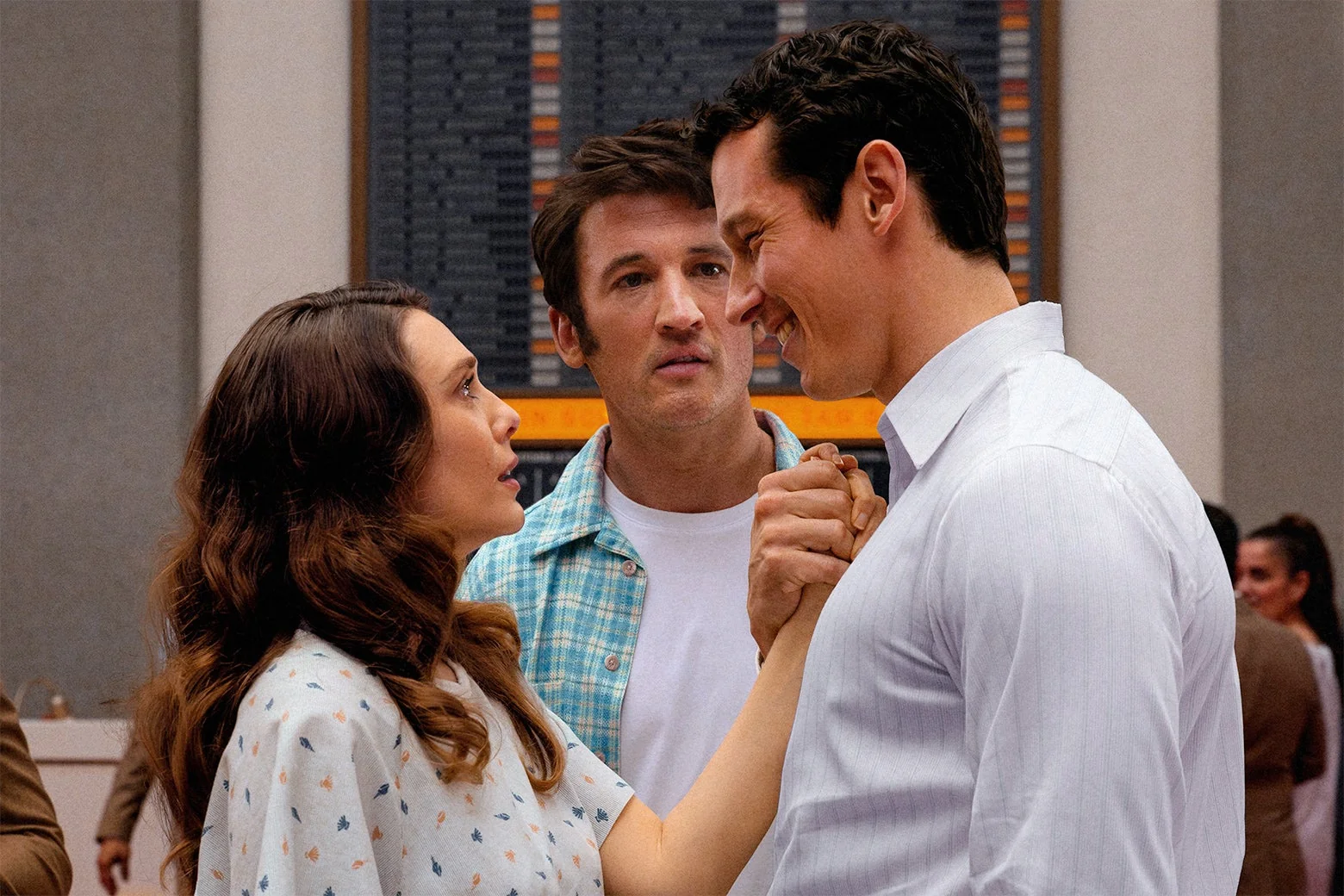
A24 has once again turned heads with its latest release, Eternity. Directed by James Ponsoldt, the film stars Elizabeth Olsen and Miles Teller, along with newcomer Callum Turner in a high-concept rom-com that aims to push the boundaries of traditional love triangle narratives. The premise, where a woman must choose between two deceased husbands upon her own death, seems promising on paper but falls short in execution.
The Concept and Initial Impression
The story revolves around Joan, a character played by Olsen who, after living an 80-year life, finds herself back as a young woman in the afterlife. She is faced with choosing between her first husband, Larry (Teller), and Luke (Turner), the man she loved but who tragically died before they could have any children together. This setup initially seemed to offer fresh ground for exploration of the love triangle trope. However, as the film unfolds, it becomes clear that its resolution is hampered by conventional Hollywood logic.
The Problematic Ending
The most significant issue with Eternity lies in its ending, which follows a familiar pattern despite the movie’s clever premise. In the afterlife setting, Joan must choose between two worlds: Mountain World (with Luke) or Beach World (with Larry). While this setup allows for some interesting world-building, it ultimately constrains the narrative by forcing a binary choice where none should exist.
The film tries to complicate matters with late revelations about Luke’s character but these attempts feel underdeveloped and unsatisfying.
“The movie waves away the notion that Joan, Larry, and Luke could all go to the same place for eternity. No, she has to pick because … she just does?” This quote, from Heather Schwadel, captures the frustration many viewers might feel towards the conventional Hollywood logic at play here. In the real world, relationships evolve over time; why should they be confined by such strict conventions in the afterlife? The film could have explored a more open-ended resolution where Joan gets to experience both men’s worlds without making an irrevocable choice.
The Business Logic of Hollywood
Despite its ambitious premise, Eternity seems to fall victim to the same business logic that often dictates how Hollywood resolves love triangle endings. The film’s logic suggests that Teller (as Larry) is more marketable than Turner (as Luke), which influences Joan’s decision despite the characters’ evolving dynamics on screen. Such decisions may be driven by commercial considerations rather than narrative coherence, leading to a disappointing conclusion.
Interestingly, this critique aligns with broader discussions about the evolution of love triangle narratives in popular culture. As Heather Schwadel notes, good love triangles are increasingly a lost art, and Eternity’s ending reflects this trend towards conventional resolution over creative exploration.
The Future of A24
While Eternity may not have lived up to its initial promise, it still offers moments of charm and humor. It serves as a reminder that even with high-concept ideas, execution matters. As A24 continues to produce films, the challenge will be balancing ambitious premises with satisfying resolutions that don’t feel like they’ve been predetermined by market forces.
Ultimately, Eternity is a case study in how even the most innovative concepts can fall short when constrained by traditional Hollywood formulas. It’s a reminder for filmmakers and studios to consider the potential of their ideas more deeply rather than settling for safe resolutions that might not fully honor the creative vision.


