
Key Highlights
- Scientists discover coiled optic nerves in chameleons that are not seen in any other lizard.
- The unique structure of the optic nerve allows chameleons to have a nearly 360-degree view and independently move their eyes.
- This discovery challenges theories proposed by Aristotle, Newton, and Panaroli about chameleon anatomy.
- CT scanning technology has played a crucial role in revealing the true structure of chameleon optic nerves.
The Hidden Secrets of Chameleons’ Vision: Coiled Optic Nerves Revealed
In a groundbreaking study published in Scientific Reports, researchers from Florida Museum of Natural History have uncovered a previously unknown anatomical feature in chameleons—coiled optic nerves. This discovery challenges centuries-old theories and opens new avenues for understanding chameleon vision.
Ancient Theories Reshaped by Modern Imaging
The study, led by Juan Daza from Sam Houston State University, highlights the evolution of scientific thought regarding chameleon anatomy over millennia. Ancient Greek philosopher Aristotle once theorized that chameleons lacked optic nerves altogether, instead claiming their eyes were directly connected to the brain. In contrast, Roman physician Domenico Panaroli suggested that chameleons do have optic nerves but without a crossing structure, allowing for independent eye movement.
These theories remained unchallenged until the 18th and 19th centuries when Isaac Newton and French anatomist Claude Perrault proposed their own interpretations. However, it was only in recent years that advanced imaging techniques like CT scanning allowed scientists to visualize chameleons’ internal structures without damaging them.
CT Scanning Reveals Unprecedented Insights
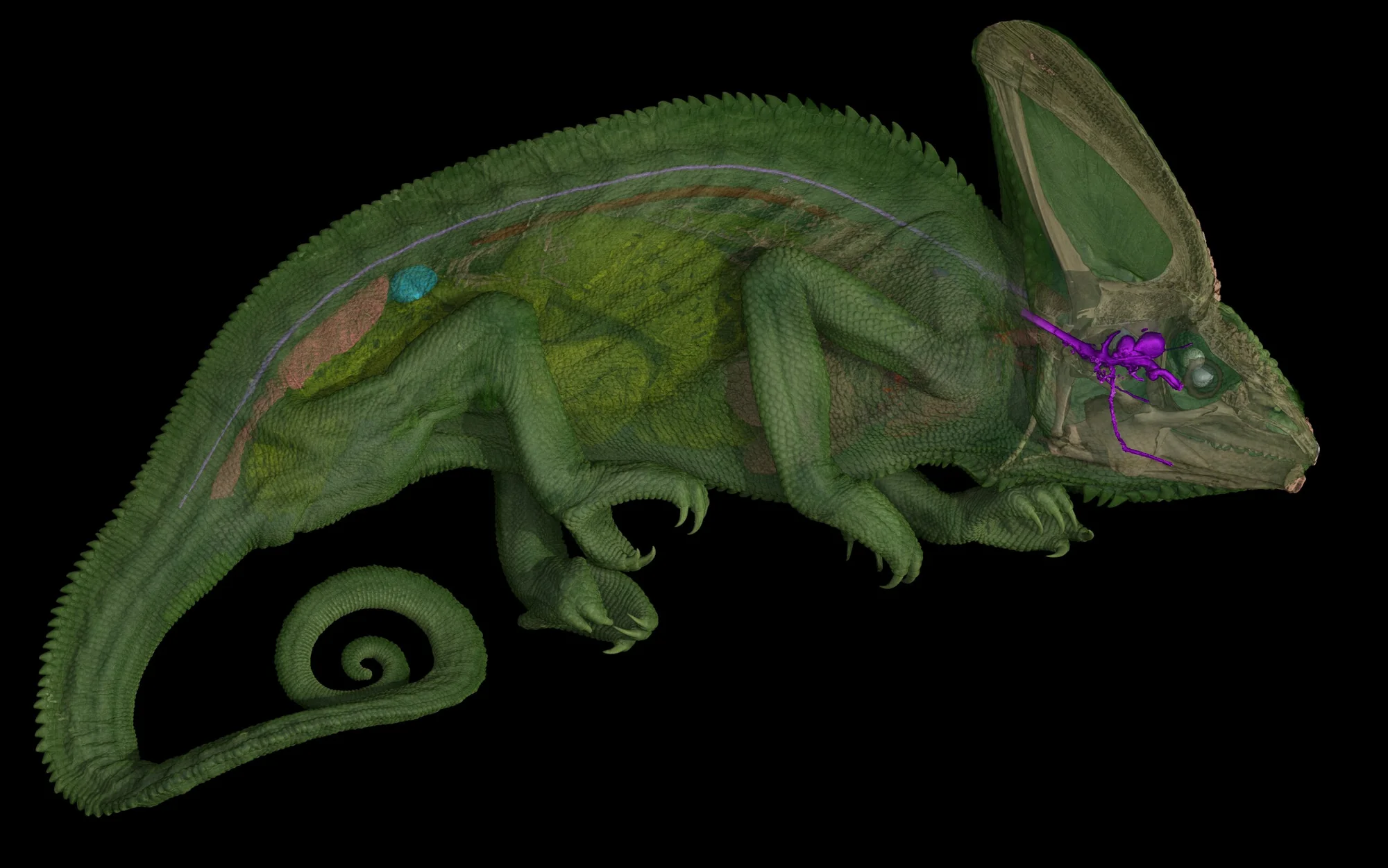
Using CT scanning technology, the researchers were able to examine the intricate anatomy of chameleons in unprecedented detail. What they discovered was a coiled optic nerve structure that had eluded scientists for centuries. According to Daza, “The first phones just had a simple, straight cord attached to the head, but then someone had the idea to coil the cord and give it more slack so people could walk farther while holding it.
That’s what these animals are doing: They’re maximizing the range of motion of the eye by creating this coiled structure.”
Scientists have found that chameleons’ optic nerves are significantly longer and more coiled than those in other lizards, contributing to their exceptional visual capabilities. The team also discovered that these unique structures develop during embryonic stages, providing insights into the evolutionary adaptations of these fascinating reptiles.
Implications for Chameleon Research
The discovery not only challenges long-held theories but also opens new avenues for understanding chameleon behavior and evolution. According to Edward Stanley from Florida Museum of Natural History’s digital imaging laboratory, “This is a significant finding that could reshape our understanding of chameleon anatomy and vision. It highlights the importance of using modern technology in scientific research.”
Stanley and Daza plan to continue their investigation into other tree-dwelling lizards to see if similar adaptations have occurred independently.
This study underscores the power of technological advancements in uncovering hidden truths within nature, pushing the boundaries of scientific knowledge.
The researchers’ findings not only contribute to our understanding of chameleons but also inspire further exploration into the natural world’s hidden secrets. As Daza concludes, “It’s exciting to be the ones taking the next step along the long road to understanding what on Earth is going on in chameleons.” This breakthrough represents a milestone in the ongoing quest for knowledge about these charismatic and unique creatures.


